The short answer
Meal prep means cooking some or all of your week’s food in one session, so weekday meals take minutes instead of an hour. For beginners, the trick is to start small: prep lunches for three or four days, in about 90 minutes on a Sunday, using one simple formula for every box: a protein, a carb, two vegetables and a sauce.
Done well, it saves time, makes it far easier to hit your protein target, and usually costs much less than buying lunch every day. Done badly, it leaves you with five identical boxes you’re sick of by Wednesday. This guide is about doing it well.
Pick a prep style
There are three ways to meal prep. You don’t have to pick one forever, but it helps to know which you’re doing.
| Style | What you do | Best for | The catch |
|---|---|---|---|
| Full meals | Cook complete meals and portion them into boxes | People who want grab-and-go lunches | Can get repetitive |
| Ingredient prep | Cook components separately (a grain, a protein, vegetables, a sauce) and assemble each day | People who like variety | Needs 5 to 10 minutes of assembly each day |
| Prep the basics | Wash and chop vegetables, boil eggs, make overnight oats | Very busy weeks, or your first try | Saves less time later in the week |
For most beginners, ingredient prep is the best place to start. You cook once, but you can still mix and match through the week, so you don’t get bored.
Equipment you actually need
You don’t need a special meal-prep kit. You need:
- 6 to 10 containers with lids, ideally all the same size so they stack. Choose glass if you’ll reheat in a microwave.
- Two sheet pans (baking trays), so the protein and vegetables can roast at the same time.
- One large pot and one large frying pan.
- A sharp knife and a large cutting board. A dull knife is the slowest part of most people’s prep.
- Masking tape and a marker to label each container with the date.
- Small sauce pots, so sauces and dressings stay separate until you eat.
Nice to have, but not essential: a rice cooker, a pressure cooker, and a kitchen scale if you track your food.
The 90-minute Sunday plan
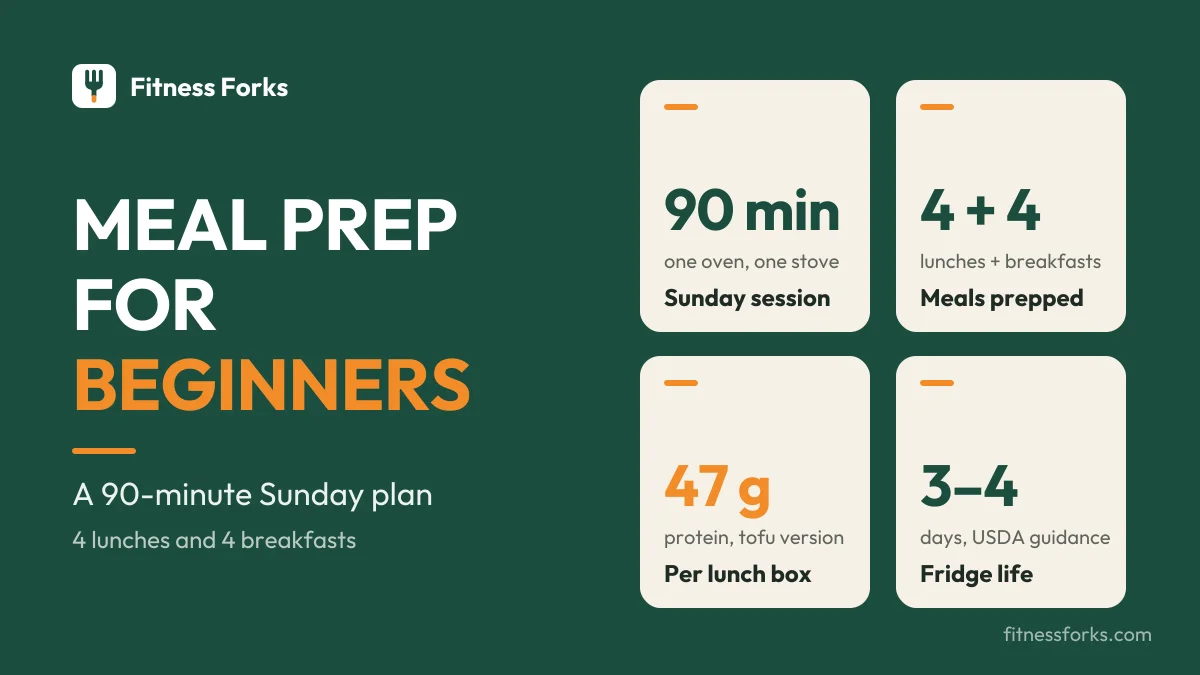
This plan makes 4 lunch boxes plus 4 breakfasts, using the ingredient-prep style. Everything cooks at the same time, so the oven and stove are never idle.
What you’ll make:
- Protein: sheet-pan tofu (or chicken), plus 6 hard-boiled eggs
- Carb: a big pot of quinoa or rice
- Vegetables: roasted broccoli and bell peppers, plus raw cucumber and carrots
- Sauce: a quick lemon yogurt-tahini sauce
- Breakfast: 4 jars of high-protein overnight oats
Shopping list: 800 g (28 oz) firm tofu or 600 g (21 oz) raw chicken breast, 6 eggs, 300 g (1½ cups) dry quinoa or rice, 2 heads of broccoli, 2 bell peppers, 1 cucumber, 3 carrots, plain Greek yogurt (about 750 g / 1¾ lb, for the sauce and oats), tahini, 2 lemons, rolled oats, chia seeds, milk, olive oil, garlic powder, smoked paprika, salt and pepper.
The schedule:
| Time | What to do |
|---|---|
| 0:00 to 0:10 | Heat the oven to 220°C (425°F). Rinse the quinoa or rice and start it cooking. Put the eggs in a pot of cold water and bring to a boil. |
| 0:10 to 0:25 | Cut the tofu into cubes (or the chicken into bite-sized pieces). Toss with 1 tbsp oil, garlic powder, paprika and salt, and spread on sheet pan 1. Cut the broccoli and peppers, toss with 1 tbsp oil and salt, and spread on sheet pan 2. |
| 0:25 | Put both pans in the oven. Once the eggs have boiled for 10 minutes, move them to a bowl of cold water. |
| 0:25 to 0:40 | While the pans roast, whisk the sauce: 150 g Greek yogurt, 2 tbsp tahini, juice of 1 lemon, a pinch of salt, and water to loosen. Slice the cucumber and carrots into sticks. |
| 0:40 | Flip the tofu or chicken and stir the vegetables. |
| 0:40 to 0:55 | Make 4 jars of overnight oats. Peel the eggs. Fluff the cooked quinoa or rice and spread it on a tray to cool. |
| 0:55 to 1:05 | Take both pans out when the tofu is golden and the vegetables are tender with charred edges. If using chicken, check it has reached 74°C (165°F) inside. Spread everything out so it cools quickly. |
| 1:05 to 1:20 | Portion 4 lunch boxes: grain, protein and roasted vegetables in each. Put the sauce in small pots and the raw vegetables and eggs in separate containers. Label everything with the date. |
| 1:20 to 1:30 | Put everything in the fridge and wash up. |
Be realistic about your first session: it will probably take closer to two hours. Most people get it down to around 90 minutes by the third week, once the order of jobs becomes automatic.
Building balanced boxes
Every box follows the same simple formula, the same one behind our plate method:
- A palm-sized portion of protein: tofu, chicken, eggs, beans, paneer or fish
- A fist-sized portion of carbs: quinoa, rice, potatoes, pasta or bread
- Two handfuls of vegetables: roasted, raw or both
- A thumb-sized amount of sauce or fat: the sauce, a few nuts, some cheese or avocado
Here’s what one lunch box from the Sunday plan gives you. Values are approximate, calculated from USDA FoodData Central, and don’t include the eggs or raw vegetable sticks.
| Per lunch box | Calories | Protein | Carbs | Fat | Fiber |
|---|---|---|---|---|---|
| Tofu version | About 680 | 47 g | 61 g | 31 g | 15 g |
| Chicken version | About 600 | 52 g | 55 g | 19 g | 10 g |
To keep it interesting through the week, change the sauce rather than the whole meal. A second sauce, such as a peanut-lime dressing or a spicy salsa, makes the same box taste completely different on day three.
How long does meal prep keep?
According to the USDA, cooked leftovers keep in the fridge for 3 to 4 days, or in the freezer for 3 to 4 months. In practice:
- Prep on Sunday, eat Monday to Wednesday or Thursday.
- For Friday, freeze one box on Sunday and move it to the fridge on Thursday night, or do a quick 20-minute mini-prep midweek.
- Cool food quickly. Spread it out on trays or in shallow containers, and get it into the fridge within 2 hours of cooking.
- Reheat until steaming hot all the way through, to 74°C (165°F). Stir halfway if using a microwave, since microwaves heat unevenly.
Mistakes beginners make
- Prepping the whole week on day one. Start with lunches only. Add breakfasts or dinners once lunches feel easy.
- Making five identical boxes. Use two sauces, or two proteins, so Thursday isn’t a chore.
- Dressing everything in advance. Sauces and dressings make grains and salads soggy. Keep them in separate pots.
- Packing hot food into deep containers. Large, deep portions cool slowly in the fridge. Let food cool on trays first.
- Choosing food that doesn’t reheat well. Fried foods go limp and delicate fish dries out. Roasted vegetables, grains, beans, curries, soups and stews all reheat well.
- Forgetting breakfast and snacks. Boiled eggs, cut vegetables and overnight oats take minutes on prep day and stop you buying snacks on the way to work.
Common questions
Is meal prep actually cheaper? Usually, yes, especially compared with buying lunch out every day. Buying grains, beans and frozen vegetables in bulk lowers the cost per box further.
Can I freeze meal prep? Soups, curries, chili, cooked grains and beans all freeze well. Salads, yogurt-based sauces and raw vegetables don’t.
What if I don’t have a whole Sunday afternoon? Split it up. Cook the grain and protein on Sunday evening, and chop vegetables and make sauces while dinner cooks on Monday.
Will I get bored? Only if every week is the same. Change one component each week, such as a new protein, a different grain or a new sauce, and keep the rest of the system.
The takeaway
Start small: four lunches, one formula, one 90-minute session. Cook the components at the same time, keep the sauces separate, cool everything quickly, and eat it within 3 to 4 days. Once that feels easy, add breakfasts, then dinners.
Note: Storage and reheating guidance in this article follows USDA food safety advice. Nutrition values are estimates and vary by brand and portion size.