The short answer
Your body weight changes over time based on energy balance: the calories you eat compared with the calories you burn. Eat less than you burn and you lose weight; eat more and you gain. That part is not in serious scientific dispute.
What makes it feel complicated is that both sides of the equation are hard to measure, they change as your weight changes, and the type of food you eat affects how much you end up eating. Understanding those three things matters far more than the basic rule itself.
What energy balance actually means
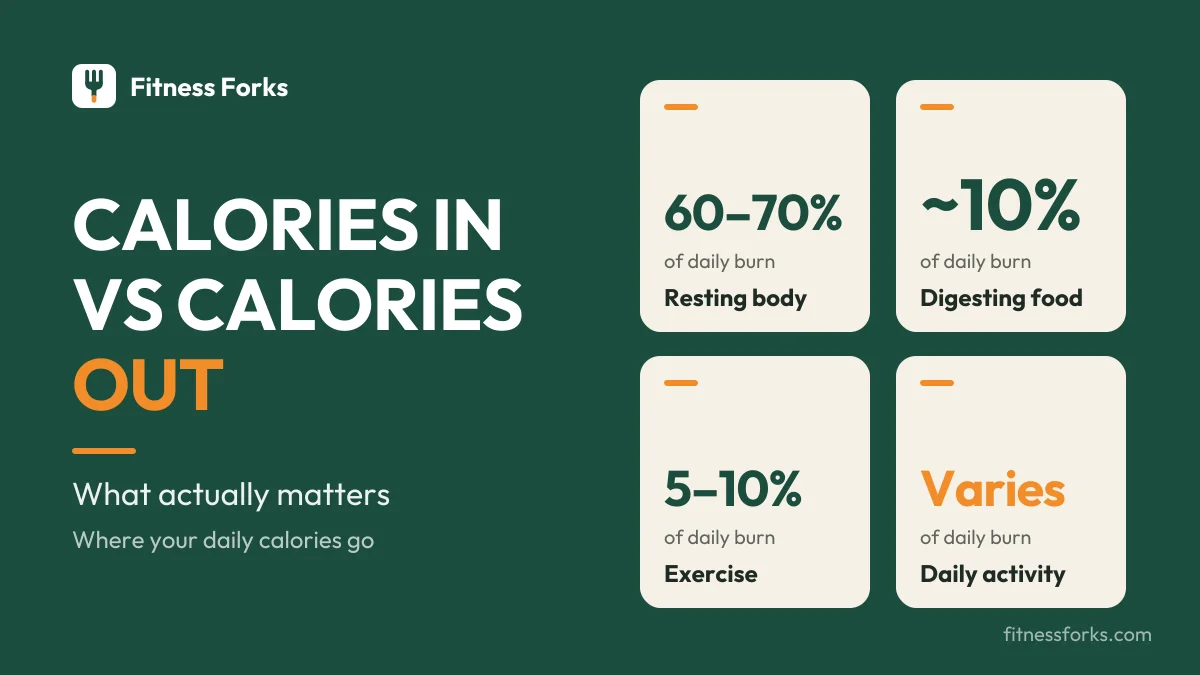
“Calories in” is everything you eat and drink. “Calories out” is more than just exercise. Your body burns energy in four main ways:
| Part of calories out | What it is | Rough share of daily burn |
|---|---|---|
| Basal metabolic rate (BMR) | Energy to keep you alive at rest: breathing, heart, brain, organs | About 60 to 70% |
| Thermic effect of food | Energy used to digest food; highest for protein | About 10% |
| Exercise | Planned workouts, sports, gym sessions | Usually 5 to 10% |
| Non-exercise activity (NEAT) | Walking, standing, chores, fidgeting, taking the stairs | The rest, and the most variable |
Two things in this table surprise most people. Exercise is usually a small slice of the total. And NEAT, the everyday movement you don’t think about, can differ by several hundred calories a day between two people of the same size, or for the same person between a busy week and a lazy one.
Why it feels like it doesn’t work
If you’ve cut calories and the scale hasn’t moved, the rule hasn’t broken. Usually one of these is happening:
- Water weight is hiding fat loss. A salty meal, a high-carb day, a hard workout, poor sleep or the menstrual cycle can shift body water by 1 to 2 kg (2 to 4 lb) overnight. Fat loss shows up over weeks, not days.
- You’re eating more than you think. Studies consistently find that people underestimate how much they eat, often by a wide margin. The table below shows where it usually comes from.
- You’re burning less than you think. Fitness trackers and gym machines often overestimate exercise calories, and people tend to move less without noticing when they diet.
- Your needs went down. A smaller body burns fewer calories. After losing weight, the amount that once created a deficit may now be closer to maintenance.
Common tracking mistakes
These are the small things that quietly add up. Calorie figures are typical estimates.
| Mistake | Typical hidden calories |
|---|---|
| Cooking oil poured, not measured (1 extra tbsp) | About 120 |
| A heaped spoon of peanut butter instead of a level one | About 50 to 100 |
| Milky coffee or tea with sugar, 2 a day | About 100 to 300 |
| Tastes, bites and finishing others’ plates | About 100 to 200 |
| Logging rice, pasta or lentils cooked but weighing them dry (or the reverse) | Easily 100 to 300 per meal |
| Weekend meals not tracked | Can undo a week’s deficit |
| Eating back exercise calories shown on a tracker | Often 100 to 300 more than burned |
None of these are mistakes in eating. They are mistakes in counting, and fixing even two or three of them often explains a plateau.
Food quality still matters
If calories are what count, does it matter whether they come from vegetables or biscuits? For your weight, the calories decide. But food quality strongly affects how many calories you end up eating.
In a 2019 National Institutes of Health study, people living in a research center were offered either ultra-processed or minimally processed meals, matched for calories, sugar, fat and fiber, and allowed to eat as much as they wanted. On the ultra-processed diet they ate about 500 calories more per day and gained weight. On the minimally processed diet they lost weight.
That is the practical lesson. Foods high in protein and fiber, and close to their natural form, keep you full on fewer calories. Highly processed foods are easy to overeat without noticing.
Practical steps without obsessive counting
- Track honestly for one or two weeks. Weigh and log everything, including oil, drinks and weekends. The point is to learn your real habits, not to count forever.
- Watch the weekly trend, not the daily number. Weigh yourself a few times a week at the same time of day and compare weekly averages.
- Build meals around protein and vegetables. They keep you full on fewer calories and protect muscle while you lose fat.
- Measure the calorie-dense extras. Oil, nut butters, cheese and sauces are where small amounts make big differences.
- Move more outside the gym. Walking and daily activity often change your total burn more than an extra workout.
- Don’t eat back tracker calories. Treat exercise as a bonus, not as permission for more food.
- Adjust slowly. If the weekly average hasn’t moved in 3 to 4 weeks, reduce intake slightly or increase daily movement, then reassess.
Common questions
Is a calorie really just a calorie? For energy, yes. For hunger, health and muscle, no. 200 calories of lentils and 200 calories of soda affect your appetite, blood sugar and nutrition very differently.
Does metabolism slow down when you diet? Somewhat. A smaller body burns less, and your body adapts a little beyond that. The effect is real but usually modest, and it doesn’t stop fat loss when intake is adjusted.
Do I have to count calories to lose weight? No. Many people lose weight by changing what they eat, eating more protein and fiber, and controlling portions without counting. Counting is a tool, not a requirement.
Is “3,500 calories equals one pound of fat” accurate? It’s a rough rule that oversimplifies. Real weight change slows over time as your body and needs change.
The bottom line
Calories in versus calories out decides whether you gain or lose weight. What makes it tricky is measuring both sides accurately and managing hunger. Track honestly for a short time, judge progress by weekly trends, and choose foods that keep you full.
Disclaimer: This article is for general information only and is not medical or dietary advice. Please consult a qualified doctor or registered dietitian before making significant changes to your diet, especially if you have a health condition.