The short answer
For most workouts under an hour, you don’t need a special plan. Start hydrated, sip water when you’re thirsty, and drink normally afterwards.
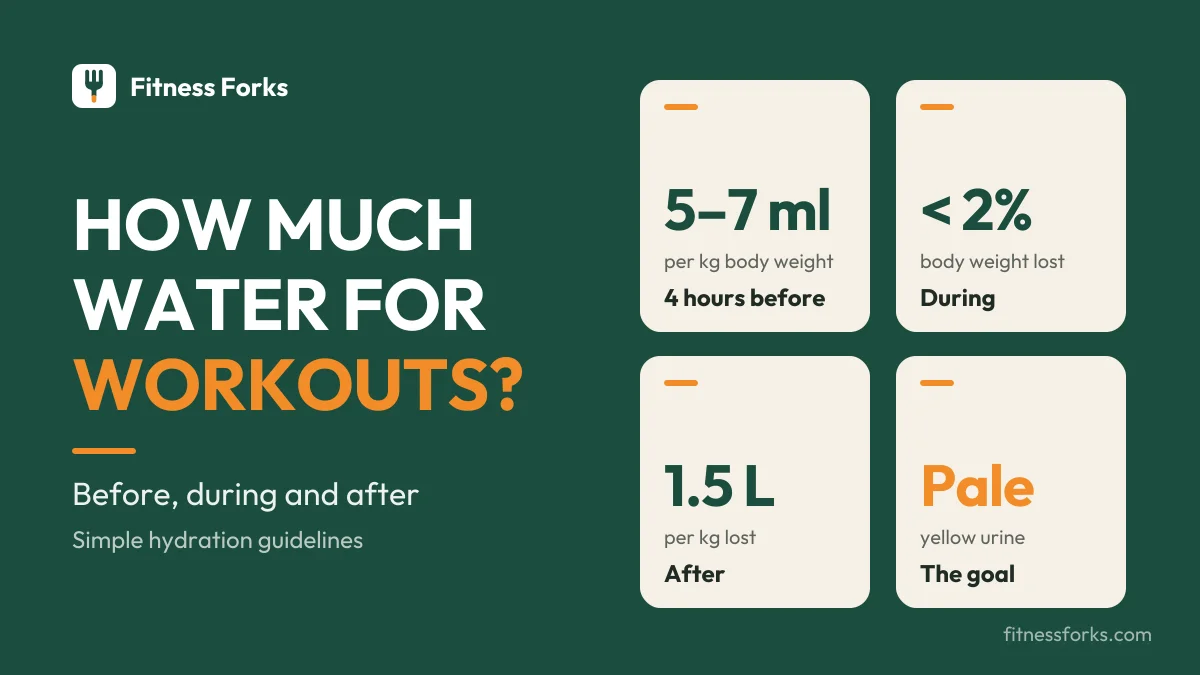
Longer sessions, hot weather and heavy sweating change that. The goal during exercise is to avoid losing more than about 2% of your body weight in sweat, because performance starts to drop beyond that point. After training, replace what you lost.
The simplest guide most people can use: pale yellow urine means you’re doing fine; dark yellow means drink more.
Your daily baseline
Before thinking about workouts, it helps to know what a normal day needs. The US National Academies suggest total water intake of roughly:
| Who | Total water per day (from drinks and food) | From drinks alone (approx.) |
|---|---|---|
| Adult women | About 2.7 L (11.5 cups) | About 2.2 L (9 cups) |
| Adult men | About 3.7 L (15.5 cups) | About 3 L (12.5 cups) |
About 20% of your water normally comes from food, especially fruit, vegetables, soups, yogurt and cooked grains. Tea, coffee and milk count toward your fluids too; the mild effect of caffeine on urine output doesn’t cancel them out for regular drinkers.
These figures are averages for temperate climates and moderate activity. Training, heat and a larger body size all push your needs higher.
Before, during and after a workout
These are the sports nutrition guidelines based on the American College of Sports Medicine’s fluid replacement position stand. The example column is for a 70 kg (154 lb) person.
| When | Guideline | Example for 70 kg |
|---|---|---|
| About 4 hours before | Drink 5 to 7 ml per kg of body weight | 350 to 490 ml (1.5 to 2 cups) |
| About 2 hours before | If urine is dark or scanty, drink another 3 to 5 ml per kg | 210 to 350 ml (1 to 1.5 cups) |
| During | Sip regularly; aim to lose no more than 2% of body weight | Often 400 to 800 ml per hour in long or hot sessions |
| After | Drink about 1.5 L for every kg of body weight lost | Lost 1 kg? Drink about 1.5 L over the next few hours |
Why 1.5 L for every 1 kg lost, rather than 1 L? Some of what you drink after exercise is passed as urine, so you need a little extra to fully catch up. Eating a normal meal with some salt helps your body hold on to the fluid.
How long and how hot: what to drink
| Your session | What to drink |
|---|---|
| Under 60 minutes, normal conditions | Water is enough |
| 60 to 90 minutes, or any hard session in the heat | Water, plus electrolytes if you sweat heavily |
| Over 90 minutes | Water, electrolytes and some carbohydrate (a sports drink, or water with a snack) |
Find your own sweat rate in one workout
Sweat rates vary hugely between people, from under half a liter to over 2 liters an hour. A simple test tells you your number:
- Weigh yourself just before a typical workout, with minimal clothing and after using the toilet.
- Train as usual for one hour. Note how much you drink.
- Towel off and weigh yourself again in the same clothing.
- Weight lost (kg) plus fluid drunk (liters) = your sweat loss for that hour.
For example: you lose 0.8 kg and drank 0.4 L, so your sweat rate is about 1.2 L per hour. Repeat the test in hot and cool weather, since the number changes a lot.
Training in hot or humid climates
Heat and humidity can sharply increase how much you sweat. In places where daytime temperatures regularly pass 30°C (86°F), such as much of South Asia, the Middle East, Australia and the southern US in summer:
- Train in the early morning or evening where you can.
- Start every session well hydrated rather than trying to catch up during it.
- Use electrolytes for any session over an hour, or shorter ones if you sweat heavily.
- Weigh yourself before and after for the first few weeks of the hot season to learn your losses.
Do you need electrolyte drinks?
Sweat is mostly water, plus electrolytes, mainly sodium. For a typical gym session or a 30-minute run, the food you eat afterwards replaces them easily, and plain water is all you need.
Electrolytes become useful when:
- Your session lasts more than about an hour.
- You train hard in heat or humidity.
- You’re a heavy or “salty” sweater (you see white salt marks on clothes or skin after training).
- You’re doing two sessions in one day.
You have three simple options: a sports drink (fluid, sodium and carbohydrate together), electrolyte tablets or powder in water (sodium without much sugar), or water with a salty snack. Check the label: many “hydration” drinks contain as much sugar as soda, which you don’t need for short workouts.
Signs you’re under-drinking
- Dark yellow urine, or going to the toilet much less than usual
- Thirst, dry mouth
- Headache or tiredness during or after training
- Feeling dizzy or light-headed when you stand up
- Workouts feeling much harder than usual at the same effort
If you feel confused, very dizzy, stop sweating in the heat or feel faint, stop exercising, get to a cool place and seek medical help. These can be signs of heat illness.
Can you drink too much?
Yes, though it’s uncommon in normal gym training. During long events like marathons, drinking far more than you sweat can dilute the sodium in your blood, a condition called hyponatremia. Symptoms include headache, nausea, bloating, swelling and confusion, and it can be serious.
The protection is simple: drink to thirst, don’t force down large amounts on a fixed schedule, and use electrolytes in long events. Weighing more after a long session than before is a sign you drank too much.
If you have kidney or heart problems, or take medication that affects fluid balance, follow your doctor’s advice on fluid intake rather than general guidelines.
Common questions
Does coffee dehydrate you? Not meaningfully for regular coffee drinkers. Coffee and tea count toward your daily fluids.
Is thirst a reliable guide? For most people in normal conditions, yes. In long, hot sessions, thirst can lag behind your losses, so plan to drink regularly.
Should I drink during weight training? Yes, sip between sets as you feel like it. Weight sessions usually cause less sweating than cardio, so you rarely need more than a bottle.
Is cold water better than room-temperature water? Cool water is more pleasant to drink and can help lower body temperature in the heat. Either works for hydration.
The bottom line
For most workouts, start hydrated, sip water as you go, and drink normally afterwards. For long, hot or very sweaty sessions, drink around 5 to 7 ml per kg in the hours before, avoid losing more than 2% of your body weight, add electrolytes, and replace about 1.5 L for every kg lost. Check your urine color: pale yellow is the goal.
Disclaimer: This article is for general information only and is not medical advice. Please consult a qualified doctor if you have a kidney, heart or other health condition, or if you experience symptoms of heat illness.